Lath-and-plaster walls: what character home buyers should know
The short answer
Usually an original feature rather than a problem. Plaster hangs on keys that squeeze behind the lath, so it fails by detaching while still looking intact — bulging and sagging matter more than cracks. It is normally repairable in place. Its real cost is renovation access: every service run means cutting it and restoring it.
Key takeaways
- Plaster is held by keys formed behind the lath, so detachment is the failure mode — sound the ceilings rather than only looking at them.
- Fine crazing and cracks along the lath lines are plaster; diagonal cracks from door and window corners are worth raising with an inspector.
- Conservation practice treats repair as the default, on condition the cause of the damage is fixed first.
- A plaster house costs more to rewire than the same house in drywall, and the restoration is usually the larger half of the bill.
What are lath-and-plaster walls and ceilings?
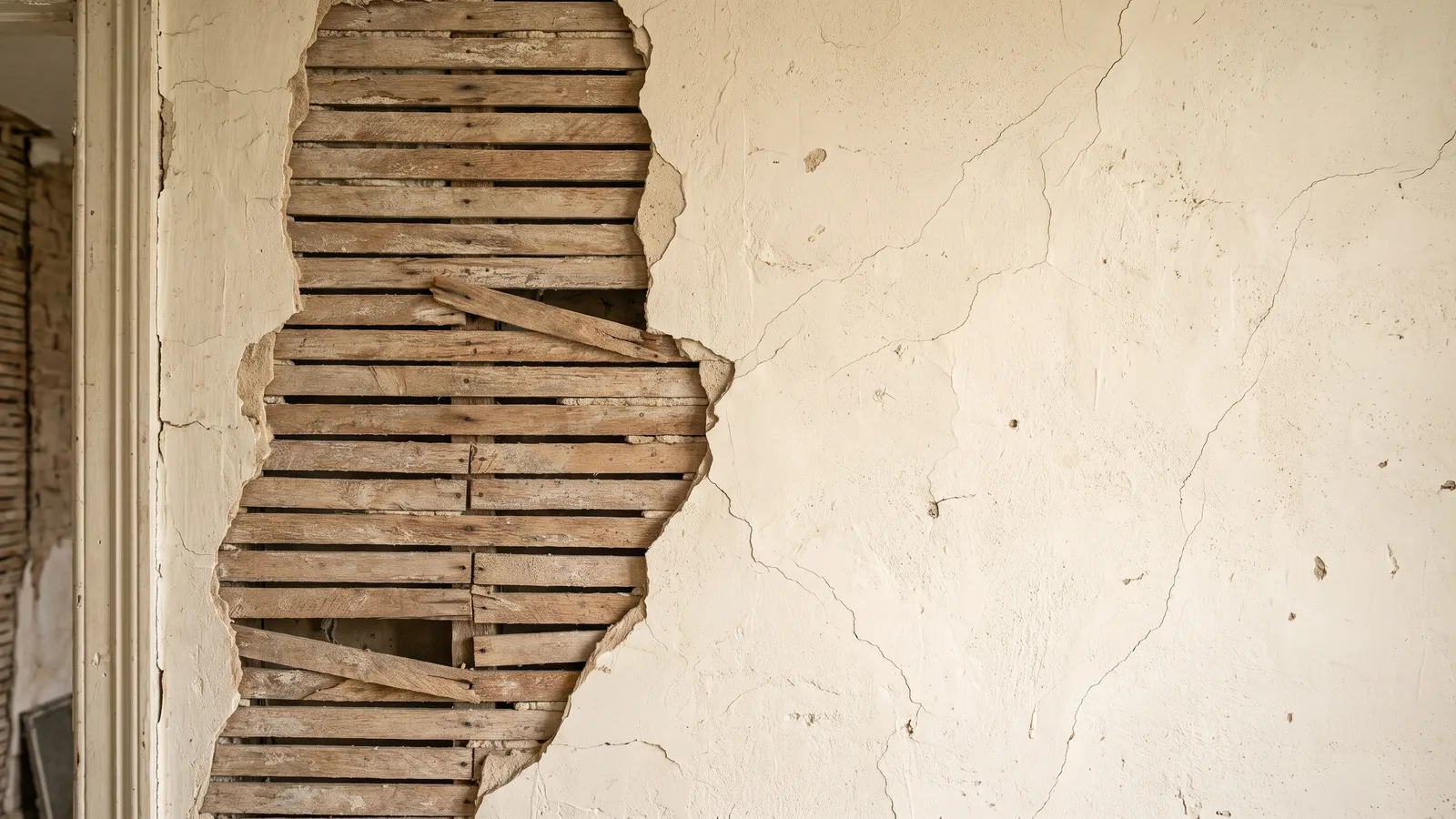
Before drywall, interior walls were built wet. Thin wood strips — the lath — were nailed across the studs with a small gap between them, and plaster was worked over the top in coats. The first coat squeezed through the gaps and slumped behind the lath, hardening into ridges called keys. Those keys are what hold the wall up.
That detail explains almost everything else about plaster. It is not fastened to the framing the way a sheet of drywall is screwed to it. It is hanging on hundreds of small hooks of its own material, and when plaster fails it is usually because those keys have broken and the plaster has come away from the lath while looking perfectly intact from the room side.
How do they differ from drywall?
In ways that matter both for living with the house and for renovating it.
| Lath and plaster | Drywall | |
|---|---|---|
| Thickness and mass | Roughly 25–30 mm of wood and plaster | 12.7 mm sheet |
| Sound | Noticeably better between rooms, from the mass | Requires added insulation or resilient channel to match |
| Surface | Slight irregularity; hard, dense finish | Flat and uniform |
| Curves and detail | Formed on site — arches, coves, mouldings | Requires specialist assemblies |
| Repair | A trade with fewer practitioners; matching texture takes skill | Any drywaller |
| Running new services | Must be cut and patched; keys break around the opening | Cut and screw a new patch |
Which cracks need closer investigation?
Most cracks in a plaster wall are the wall being ninety years old, not the house being in trouble. The distinctions worth making:
Fine crazing — a map of hairlines across a surface — is a surface-coat phenomenon and generally cosmetic. Straight cracks following the lath lines, usually horizontal and regularly spaced, are the plaster telling you where the boards behind it are, and are a plaster matter rather than a structural one.
Diagonal cracks running from the corners of doors and windows are the ones worth raising with an inspector. Openings concentrate stress, so that is where movement in the structure shows up first — which does not mean movement is happening, only that this is the crack that could be reporting it. The question to ask is whether it is old and stable or new, which is the same question a foundation crack raises.
What can bulging, sagging or staining indicate?
These are more informative than cracks, and less commonly understood.
Bulging or a section that moves under light hand pressure means the keys have broken and the plaster is no longer attached to the lath behind it. On a ceiling that is a safety matter as well as a repair one, because plaster is heavy. It is also specifically fixable — see below.
Sagging ceilings raise the same question with more urgency. Staining is water, and the stain is the least important part of it: plaster is porous and absorbs, so a stain marks where water arrived, and the thing to find is where it came from. A stain that has been painted over without the source being fixed is a common finding and worth asking about directly.
Can original plaster be repaired?
Usually, and the conservation literature is unambiguous that repair should be the default. The US National Park Service's guidance on historic plaster treats replacement as the exception, with the condition that whatever caused the damage is addressed first — otherwise the repair fails the same way.
The technique for failed keys is well established: small washers are screwed through the plaster into the lath or the framing behind, drawing the loose plaster back and holding it there mechanically, and the heads are then filled and finished. It is far less disruptive than tearing a ceiling out, and it keeps the original surface.
The practical constraint is finding someone who does it. Plaster repair is a smaller trade than drywall, and a contractor whose first instinct is to board over everything is telling you about their trade rather than about your house.
How does plaster affect rewiring and renovation access?
This is where plaster stops being a finish question and becomes a budget question, and it is the main reason this article and the wiring one belong together.
Every service run through a plaster wall is a cut, and every cut breaks keys beyond the opening itself, so the repair is always wider than the hole. That is why rewiring a plaster house costs more than rewiring the same house in drywall, and why a quote that does not state whether restoration is included is not a quote you can compare.
The same applies to insulation. Blowing insulation into the wall cavities of a plaster house means drilling a pattern of holes and patching every one, and in a house with continuous framing cavities the fill behaves differently again.
The useful move is to sequence rather than repeat. If wiring, insulation and any plumbing work are all likely within a few years, doing them while the walls are open once is a different project from doing them three times.
What should be assessed before disturbing older finishes?
Two things, and both are cheap relative to getting them wrong.
Textured finishes and some plaster and joint materials from this era can contain asbestos. Health Canada's guidance is that suspected material should be assessed by a professional before it is disturbed — which is a testing question ahead of demolition, not a reason to avoid the house. Painted plaster and the trim around it may also carry lead paint, which is stable intact and becomes an exposure when sanded, stripped or heat-gunned.
Neither is a walkthrough finding. Both are a phone call before a contractor opens anything, and both are far easier to arrange during a condition period than after possession.
What should buyers ask an inspector or plaster specialist?
Ask the inspector to distinguish cosmetic crazing from cracking at opening corners, and to sound the ceilings rather than only look at them — detachment is audible before it is visible. Ask whether any staining has a source that has been identified, and whether any wall reads as recently skimmed, which can be maintenance or can be cover.
If a rewire or significant renovation is part of your plan, get a plaster specialist's view during the condition period rather than the contractor's. The question to put to them is narrow and useful: how much of this is repairable in place, and what would restoration cost on top of whatever the other trades quote?
The character-home series
Start with the overview if you have not read it: Buying a character home in Edmonton: what to look for. These four go deeper on one system each.
3. Lath-and-plaster walls (you are here)
Edmonton’s market right now
514 of Edmonton's 6,023 active listings were built in 1960 or earlier — the stock most people mean by “character home”. The city-wide median list price is $425,000, or about $297 per square foot.
| Price band | Listings | Share |
|---|---|---|
| Under $300,000 | 1,823 | 30% |
| $300,000 – $500,000 | 2,059 | 34% |
| $500,000 – $750,000 | 1,515 | 25% |
| $750,000 – $1M | 303 | 5% |
| $1M and up | 323 | 5% |
Source: Real Living’s CREA DDF® feed, active Edmonton residential listings as of 18 September 2026. Figures refresh several times a day; extreme outliers are excluded so a median reflects the real market. Search every listing.

Ryan McCann
Ryan McCann is an Edmonton REALTOR® with over 23 years of experience helping more than 2,200 buyers and sellers. His work spans every Edmonton neighbourhood and property type, bringing deep local market knowledge and practical guidance to buying or selling a home in Edmonton.
He lives in Westmount in a 1912 home he rebuilt from the ground up, and works regularly with buyers and sellers of Edmonton’s pre-war character housing.
Contact Ryan today at 780-964-8445 to talk through your next step.
Reviewed 18 September 2026
Sources
National Park Service (US), repairing historic plaster — cited for conservation practice, not for any Canadian requirement — https://www.nps.gov/articles/should-i-replace-my-plaster-ceiling.htm
Health Canada, health risks of asbestos — https://www.canada.ca/en/health-canada/services/air-quality/indoor-air-contaminants/health-risks-asbestos.html
This article is general information about older houses, not a verdict on any particular one. Condition varies property by property; confirm anything that affects your decision with a qualified inspector, electrician or engineer.
Frequently asked questions
Should I replace plaster with drywall?
Not by default. Plaster is thicker, better at sound, and part of what the house is. Replacement is normally the answer only where the plaster is beyond repair or the wall has to come out anyway.
Can sagging plaster ceilings be repaired?
Often, yes. Washers screwed through into the lath or framing draw the loose plaster back and hold it mechanically, and the heads are filled and finished — far less disruptive than tearing the ceiling out.
Does plaster contain asbestos?
Some textured finishes and materials from this era can. Health Canada's guidance is to have suspected material assessed by a professional before it is disturbed, which makes it a question to settle before demolition rather than after.
Why is rewiring more expensive in a plaster house?
Because every opening breaks keys beyond the hole itself, so the patch is always wider than the cut. Ask whether a quote includes plaster restoration or excludes it.
Are cracks in plaster a structural problem?
Most are not. The ones worth investigating run diagonally from the corners of doors and windows, because openings are where movement in the structure shows first.
Your next step
Every active Edmonton listing, on one map — with the neighbourhood detail to tell the good ones apart.
Search Edmonton homes