Buying a home with knob-and-tube wiring in Edmonton
The short answer
Knob-and-tube only matters if it is still live, and looking at it will not tell you. A newer panel does not mean the house was rewired. Have an electrician confirm which circuits are energised, then call your own insurer before financing conditions come off — that answer decides more purchases than the wiring does.
Key takeaways
- Knob-and-tube is frequently abandoned in place, so seeing it proves it exists, not that anything runs through it.
- A panel upgrade and a rewire are separate jobs; a modern panel can feed entirely original branch circuits.
- Insurers set their own rules and some will decline it — your broker's answer on the actual address is the one that counts.
- Almost none of the replacement cost is wire. It is access: opening walls and ceilings, and putting them back.
What is knob-and-tube wiring?
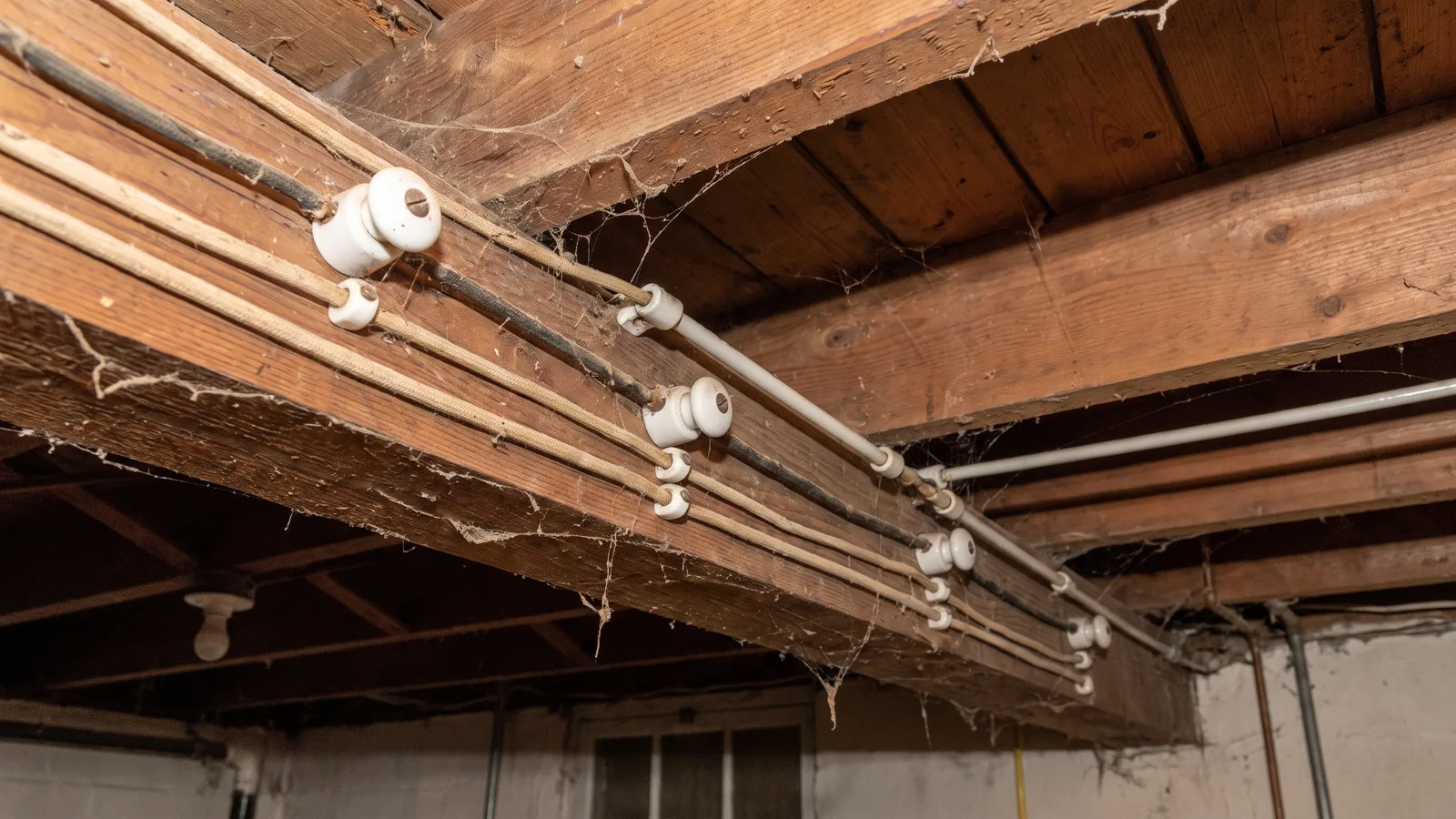
Knob-and-tube was the standard way to wire a house from roughly the 1900s to the 1940s, which puts it squarely under a lot of Edmonton's mature-neighbourhood stock. Two separate conductors — a hot and a neutral — run through the framing on their own, held away from the wood by ceramic knobs and passed through joists inside ceramic tubes. That is where the name comes from.
Two things about it matter to a buyer. There is no ground conductor, which is why houses of this era have two-prong outlets. And the insulation is rubber and cloth rather than the thermoplastic used since, so it becomes brittle with age and heat in a way modern wire does not.
None of that makes it dangerous by definition. A knob-and-tube circuit that has never been disturbed, never been buried in insulation and never been asked to carry a modern load can be in sound condition. The problems are what happens to it over ninety years: amateur splices, blown-in insulation packed around conductors designed to shed heat into open air, and circuits carrying loads nobody imagined in 1925.
How can you establish whether it is still active?
This is the question, and it is not one you can answer by looking. Knob-and-tube is frequently abandoned in place — a previous rewire left the old conductors in the walls because pulling them out means opening the walls. So seeing it in the basement tells you it exists; it does not tell you anything is running through it.
A home inspector will report that knob-and-tube is present, which is genuinely useful and where most buyers stop. Confirming whether any of it is live is a different job and takes an electrician, who can test at the panel and trace what is actually energised.
Ask for that distinction explicitly, in writing. “There is knob-and-tube in the attic” and “there are four live knob-and-tube circuits serving the second floor” are different houses, and only the second one is a project.
Does a newer electrical panel mean the house has been rewired?
No, and this is the single most common misunderstanding in this segment. A panel and the branch circuits behind it are separate pieces of work, and replacing the first is far cheaper and far less disruptive than replacing the second.
A modern 100- or 200-amp panel can sit at the end of a service upgrade and still feed original wiring throughout the house. The panel is what an owner replaces when they need capacity for a furnace or a hot tub; the branch circuits are what they replace when they are already opening the walls for other reasons.
So “updated electrical” in a listing is not a claim you can price until somebody defines it. Ask which circuits were replaced, and what remains. A seller who had the work done will usually know; a seller who bought the house that way often does not, which is its own useful answer.
What should an electrician assess?
Ontario's Electrical Safety Authority recommends having knob-and-tube assessed by a licensed electrician rather than judged on sight, which is sound practice anywhere. What is worth having on the report:
| What to confirm | Why it matters |
|---|---|
| Which circuits are live | Separates an abandoned remnant from an active system |
| Whether insulation is in contact with conductors | The wiring was designed to shed heat into open air |
| Splices and junctions outside boxes | Amateur extensions are the common failure point, not the original work |
| Condition of the rubber and cloth insulation | Brittleness and crumbling are age-driven, not visible from a distance |
| Service capacity and panel condition | Separate from the branch wiring, and separately costed |
| Whether grounding exists anywhere | Affects what you can safely plug in, room by room |
Can knob-and-tube wiring affect home insurance?
Yes, and for most buyers this is the part that decides the purchase rather than the safety question. Be careful what you read: knob-and-tube is not universally uninsurable, and the confident articles saying so are usually describing another jurisdiction or another decade.
What is true is that insurers treat it as a rated risk and set their own rules. The ESA notes that insurers' requirements can extend to replacement. In practice you will find companies that decline it, companies that write it with a surcharge, and companies that will cover it on condition that it is replaced within a set period.
The only answer that matters is your own insurer's. Call your broker during the condition period, before financing comes off — not after possession, when your options have narrowed to whoever will take it. Alberta requirements and your insurer's underwriting are separate checks, and neither is settled by an article.
What records should the seller provide?
Ask for documents rather than descriptions. What is worth having:
Electrical permits and passed inspections for any rewiring work, which is the difference between work that was reviewed and work that was merely done. The electrician's invoice, because it describes scope in a way a listing never does — how many circuits, which floors, whether the service was included. Any prior electrical assessment, particularly one commissioned for insurance.
If none of that exists, that is information too. It means the scope of what has been done is unknown to the seller as well, and your own electrician's assessment is the only record that will exist.
What affects the scope and cost of replacement?
Almost none of the cost is the wire. It is access — getting to the runs, and putting the house back afterwards.
The drivers are the ones you can see on a walkthrough if you know to look for them. Plaster over wood lath is harder to open and harder to restore than drywall, so a plaster house costs more to rewire than an otherwise identical one that was boarded over in the eighties. A finished basement means the easiest access route is already covered. Balloon framing can help, because continuous cavities give a route between floors, while blown-in insulation in those same cavities makes fishing wire much harder. Two storeys cost more than one. Original trim and built-ins that you want kept mean careful removal rather than demolition.
This guide carries no dollar figures deliberately, because a range copied from a national article is worse than no number: it is the access that varies, and access is specific to the house. Get a quote on the actual property during the condition period, and make sure it says whether restoration — plaster, paint, trim — is included or excluded.
What should buyers resolve before proceeding?
Four things, in order. Is any of it live? An electrician, not an inspector. Will your insurer write it? Your own broker, on the actual address, before financing comes off. What did the previous work cover? Permits and invoices, not adjectives. What would the rest cost on this house? A quote that names what is included and what is not.
With those four answered, knob-and-tube is a number rather than a worry — and often a smaller number than the buyer who walked away assumed. Without them it is an open-ended risk sitting under an offer, which is the one version genuinely worth avoiding.
The character-home series
Start with the overview if you have not read it: Buying a character home in Edmonton: what to look for. These four go deeper on one system each.
1. Knob-and-tube wiring (you are here)
Edmonton’s market right now
Edmonton has 6,023 active MLS® listings right now, with a median list price of $425,000, a median size of 1,328 sq ft, and a median of $297 per square foot.
| Price band | Listings | Share |
|---|---|---|
| Under $300,000 | 1,823 | 30% |
| $300,000 – $500,000 | 2,059 | 34% |
| $500,000 – $750,000 | 1,515 | 25% |
| $750,000 – $1M | 303 | 5% |
| $1M and up | 323 | 5% |
Source: Real Living’s CREA DDF® feed, active Edmonton residential listings as of 18 September 2026. Figures refresh several times a day; extreme outliers are excluded so a median reflects the real market. Search every listing.

Ryan McCann
Ryan McCann is an Edmonton REALTOR® with over 23 years of experience helping more than 2,200 buyers and sellers. His work spans every Edmonton neighbourhood and property type, bringing deep local market knowledge and practical guidance to buying or selling a home in Edmonton.
He tracks the Edmonton market daily and works from what is actually selling rather than from headlines, which is the same standard he applies to a client’s own pricing.
Contact Ryan today at 780-964-8445 to talk through your next step.
Reviewed 18 September 2026
Sources
Electrical Safety Authority (Ontario), knob-and-tube wiring — cited for the assessment approach; Alberta requirements and your own insurer are separate checks — https://esasafe.com/home-renovation-buying-and-selling/knob-and-tube/
This article is general information about older houses, not a verdict on any particular one. Condition varies property by property; confirm anything that affects your decision with a qualified inspector, electrician or engineer.
Frequently asked questions
Is knob-and-tube wiring illegal in Alberta?
No. Existing installations are not banned by being old. What varies is how insurers treat them, and whether any particular circuit is safe in its current condition — which is an electrician's assessment, not a legal question.
How can I tell if knob-and-tube is still live?
You cannot tell by looking, and a home inspector will normally report only that it is present. Confirming which circuits are energised takes an electrician testing at the panel.
Does insulation around knob-and-tube matter?
Yes. The wiring was designed to shed heat into open air, so insulation packed around it is a recognised concern and one of the specific things to have assessed.
Will a home inspection be enough?
For identifying it, yes. For deciding what to do about it, no — you want an electrician's assessment and your own insurer's position before conditions come off.
What does 'updated electrical' mean in a listing?
Nothing specific until someone defines it. Ask which circuits were replaced, what remains original, and whether there are permits and invoices describing the scope.
Your next step
Every active Edmonton listing, on one map — with the neighbourhood detail to tell the good ones apart.
Search Edmonton homes