
The short answer
Alberta has ordered Edmonton to amend its zoning bylaw by January 22, 2027 so that uses, density and height on RS lots match the old bylaw as of December 31, 2023, and to bring back pre-2020 parking minimums. Homes already built aren’t affected. What changes is what can be built next: fewer homes per lot in most mature neighbourhoods.
Key takeaways
- On October 22, 2026, Alberta ordered Edmonton to amend Zoning Bylaw 20001 so RS (Small Scale Residential) lots match the old Bylaw 12800’s uses, density and height as of December 31, 2023.
- It also brings back the minimum parking rules in place on July 1, 2020, before Edmonton dropped them.
- The order gives the City three months to pass the amendment and put it into force, which the City puts at January 22, 2027. The City expects the draft bylaw and reports by mid-December.
- Complete RS applications in by November 8, 2026 are expected to get a decision under the current rules. Later ones fall under the amended rules.
- Homes already built aren’t affected. The change is to what can be built next, which matters most to lot value and to buyers of homes beside a lot that could redevelop.
What the Province ordered
On October 8, Premier Smith said the Province would make Edmonton roll back its infill rules. On October 22 it did, with Order in Council 353/2026, the City Land Use Bylaw Direction Regulation.
The order tells Edmonton to amend Zoning Bylaw 20001, the bylaw that took effect on January 1, 2024. It covers the RS zone, Small Scale Residential, which takes in most house lots in the city, including nearly every mature neighbourhood. Three things have to change:
- Uses, density and height on RS lots have to be comparable to what the old Zoning Bylaw 12800 allowed as it read on December 31, 2023.
- Parking minimums come back, matching the rules as they stood on July 1, 2020. Edmonton dropped its minimum parking requirements later that summer, so this restores the rules from just before.
- A wider review. The City also has 18 months to review the rest of the bylaw against the Province’s infill policy.
The order talks about RS lots. The Infill Development in Edmonton Association, the builders’ group, reads it as touching only uses, density, height and parking. On that reading, setbacks, site coverage and design rules stay as they are, and lots rezoned out of RS since 2024 aren’t covered. That’s their reading, not the City’s, but it matches the order’s wording.
The dates that matter
| Date | What happens |
|---|---|
| October 22, 2026 | Order in Council 353/2026 issued |
| November 8, 2026, 11:59 pm | Cut-off for complete RS applications expected to be decided under current rules |
| December 10 to 15, 2026 | Reports and draft bylaw expected |
| By January 22, 2027 | Council public hearing on the amendment |
The City says complete applications received by the November 8 cut-off are expected to get a decision before the amendment, depending on volume. Anything after that, or anything still undecided on the amendment date, falls under the new rules. Rezoning applications carry on through the normal process.
What actually changes on a mature-neighbourhood lot
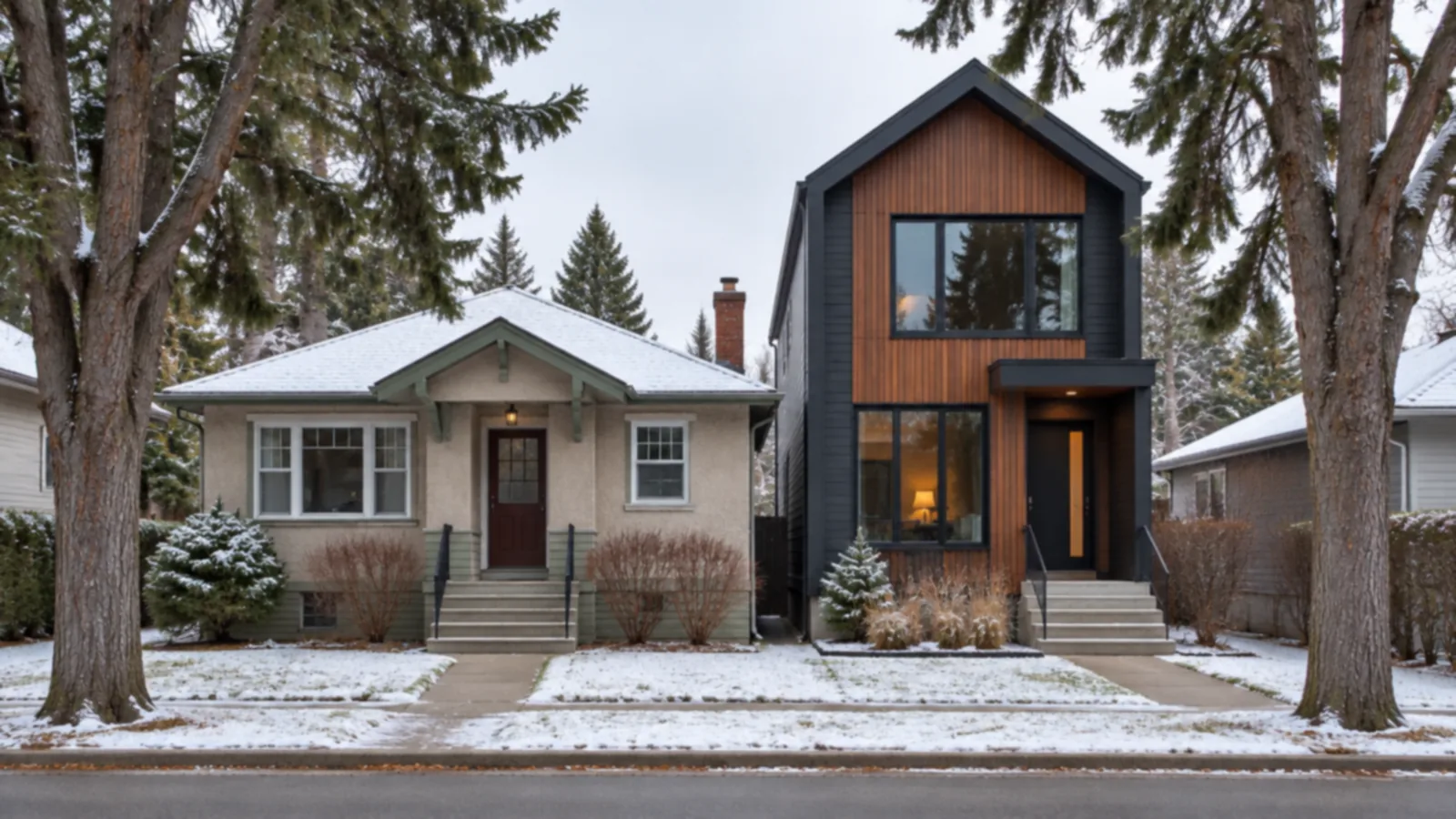
Today the RS zone allows up to eight homes on an interior lot, in buildings up to three storeys. That’s what made the skinny-house pairs, the fourplexes and the eight-unit row buildings possible on ordinary streets in Westmount, Grovenor, Alberta Avenue and Inglewood.
Under the old bylaw, most of those same lots were in the RF1 zone, Single Detached Residential, which was built around one house per lot. I’m not going to guess at the exact numbers in the amendment. The City hasn’t published its draft, and the order only says “comparable”. But the direction is clear: fewer homes per lot, and probably lower buildings.
It helps to think of it as two doors. Before 2024, infill on these streets mostly meant splitting a lot into two skinny houses, or building a duplex or semi-detached pair. Bylaw 20001 opened a second door to fourplexes and eight-unit row buildings on the same lots. The order mostly closes that second door. Skinny homes on split lots were common under the old rules, so I’d expect to keep seeing those.
Parking may matter as much as density. A multiplex with no parking requirement works on a 50-foot lot. Add a stall per unit and on many lots it doesn’t.
If you own in a mature neighbourhood
Your house doesn’t change. It stays legal, and so does the fourplex down the street that went up last year.
What may change is what your lot is worth to a builder. Over the past two years, some older homes on good lots sold to builders who were paying for what they could put there. A wide lot, a corner, a back lane, a short walk to transit. If fewer homes can go on that lot, a builder will pay less for it. If you were counting on selling to one, find out what the amended bylaw allows before you price.
It also cuts the other way. If you live beside an older home on a big lot, the chance of an eight-unit building going up next door just dropped. Some owners will see that as a loss for the city and a win for their street. Both can be true.
If you were never going to sell to a builder, this probably matters less than the headlines suggest. Most mature-neighbourhood homes sell to people who want to live in them.
If you’re buying
For any house in an older neighbourhood right now, I’d ask two questions: what could go up next door, and under which rules?
- An infill home that’s already built isn’t affected. It has its permits and stays legal. If anything, there may be fewer new ones competing with it in a few years.
- A house next to an older home on a big lot is less likely to end up beside an eight-unit building than it was in October. Check the permits on the block anyway. A permit issued before the amendment can still be built.
- A lot you plan to build on is the risky one. Don’t firm up on the assumption that today’s rules will apply. Make the deal conditional on what the City will actually let you build, or wait for the draft bylaw.
- A garden suite or basement suite you plan to add. Both were allowed under the old bylaw, so I don’t expect them to disappear. Parking rules may change what fits, though. My posts on garden and garage suites and legal basement suites cover the rest.
Every neighbourhood page on this site lists the building permits the City issued there in the last 12 months. It’s the quickest way to see what’s going up on a block. My page on infill homes for sale in Edmonton shows what’s on the market now.
If you’re selling
For most sellers in mature neighbourhoods, nothing changes. Your buyer is a family, not a developer.
If your home’s value rests on the lot, timing matters. Builders are already pricing in the uncertainty, and some will wait for the draft before making offers. You can list now and expect offers that hedge, or wait for the rules and price against them. Neither is wrong. What I’d avoid is pricing as if it were still September.
There’s an odd twist on the financing side. The federal budget’s new multi-unit mortgage rules are meant to make small multiplexes easier to finance from February 1, 2027, just as Alberta makes many of them harder to build here. I go through that in what the 2026 federal budget means for Edmonton real estate.
What the order doesn’t touch
A lot of the coverage made this sound like the end of infill in Edmonton. It isn’t, at least not from what’s in the order.
- Other zones. The order is about the RS zone. The medium-scale zones, like RSM and RM, aren’t named in it, and neither are lots that were rezoned out of RS after 2024.
- Rezoning. A builder can still apply to rezone a lot, and the City says those applications carry on with their normal notice and public hearing.
- What’s already built. Every legal home stays legal, whatever it is.
Questions to ask before you buy or sell in an older neighbourhood
- What zone is the lot in today? The City’s zoning map will tell you in a minute.
- Are there development permits on the block that were issued before the amendment?
- If you’re selling, is your likely buyer a family or a builder? That decides whether this matters to your price at all.
- If you’re buying to build, is the offer conditional on what the City will actually approve?
- Does your plan depend on a suite? If so, how would a parking requirement fit on the lot?
If you’re not sure how any of this applies to a specific house, send me the address. It’s usually a quick answer.
What I’m watching
The draft bylaw in mid-December is the real news. It will say how many homes can go on an RS lot, how tall they can be and how much parking they need. Until then, anyone who tells you exactly what the new rules are is guessing.
If you want a say, the public hearing is where it happens. Council publishes the agenda before the hearing, and you can register to speak or send in a written submission.
I’ll update this post after the public hearing. If you’re weighing an older inner-city home against a newer suburb in the meantime, infill versus a suburban new build walks through the trade-offs that don’t depend on zoning.
What’s for sale in these neighbourhoods right now
Live inventory for the communities this guide covers, straight from the MLS® feed. Each name links to its full neighbourhood page.
| Neighbourhood | For sale | Median price | Starting from |
|---|---|---|---|
| Westmount | 63 | $450,000 | $84,800 |
| Alberta Avenue | 42 | $300,000 | $140,000 |
| Inglewood (Edmonton) | 28 | $399,950 | $115,000 |
| Grovenor | 20 | $579,000 | $209,900 |
Source: Real Living’s CREA DDF® feed, active Edmonton residential listings as of 24 November 2026. Figures refresh several times a day. Browse every Edmonton neighbourhood.

Ryan McCann
Ryan McCann is an Edmonton REALTOR® licensed since 2003, with more than 2,200 homes sold. His work spans every Edmonton neighbourhood and property type, bringing deep local market knowledge and practical guidance to buying or selling a home in Edmonton.
He tracks the Edmonton market daily and works from what is actually selling rather than from headlines, which is the same standard he applies to a client’s own pricing.
Contact Ryan today at 780-964-8445 to talk through your next step.
Sources
Alberta King’s Printer, Order in Council 353/2026 — kings-printer.alberta.ca
City of Edmonton, Permits, Development and Construction (provincial direction and timeline) — edmonton.ca
City of Edmonton, Zoning Bylaw — edmonton.ca
Infill Development in Edmonton Association, letter to members on A.R. 255/2026, 28 October 2026 — infilledmonton.com
Taproot Edmonton, Edmonton ordered to revert to former zoning bylaw — edmonton.taproot.news
Current as of November 19, 2026. The City’s draft amendment wasn’t public yet. This post will be updated after the public hearing.
Frequently asked questions
What did the Province order Edmonton to do?
Under Order in Council 353/2026, dated October 22, 2026, Edmonton has to amend Zoning Bylaw 20001 so that permitted uses, density and height in the RS (Small Scale Residential) zone are comparable to the old Zoning Bylaw 12800 as of December 31, 2023, and restore minimum parking requirements as of July 1, 2020.
When does the infill rollback take effect?
The order gives Edmonton three months to pass the amendment and bring it into force. The City puts that deadline at January 22, 2027, with the public hearing before it. The City expects reports and the draft bylaw around December 10 to 15, 2026. The new rules apply once council passes the amendment.
What happens to development permits already in the system?
The City says complete applications for development in the affected RS zone received by 11:59 pm on November 8, 2026 are expected to get a decision before the amendment, depending on volume. Applications after that, or without a decision by the amendment date, fall under the amended rules.
Does the order affect my existing home?
Not the home itself. A house, duplex or multiplex that was legally built stays legal. The order changes what can be built on RS lots from now on, which can affect a lot’s value to a builder and what can go up next door.
Can I still build a garden suite in Edmonton?
Garden suites and secondary suites were allowed under the old bylaw too, so I don’t expect them to disappear. But the details, including parking, depend on how the City writes the amendment. Wait for the draft bylaw before you count on one.
Your next step
Every active Edmonton listing, on one map — with the neighbourhood detail to tell the good ones apart.
Search Edmonton homesMore in Market & data
 Edmonton Real Estate Market, Fall 2026: My Take on the Rest of the Year
 Why Buy Real Estate in Edmonton in 2026
 Days on Market in Edmonton (2026): What High DOM Signals for Buyers & Sellers
 The Truth About Price Per Square Foot in Edmonton Real Estate (2026)